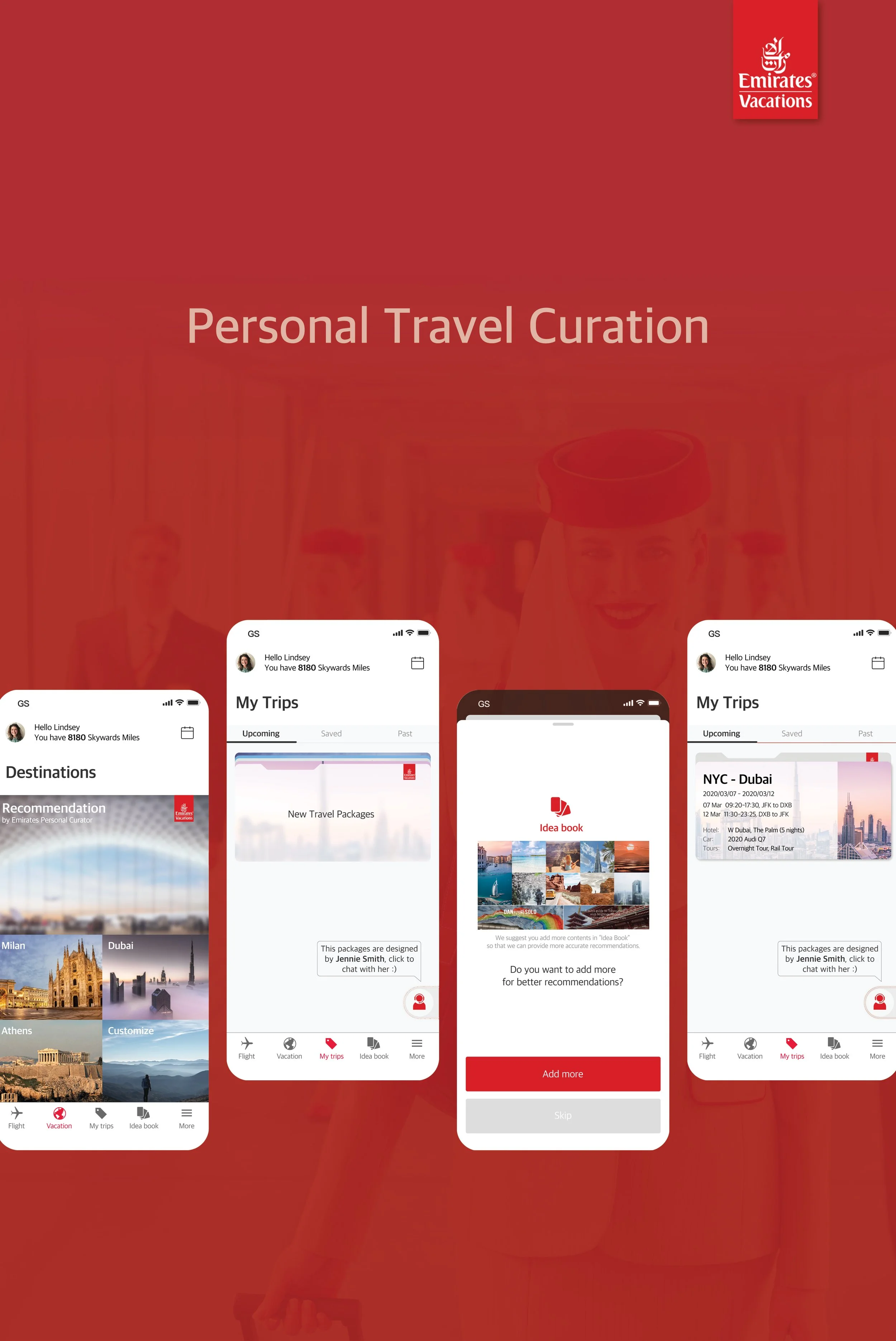
Personal Travel Curation
A digital service that assists busy travelers with planning and booking vacations
by discovering the best balance between real-time needs of customers and potential market offerings.
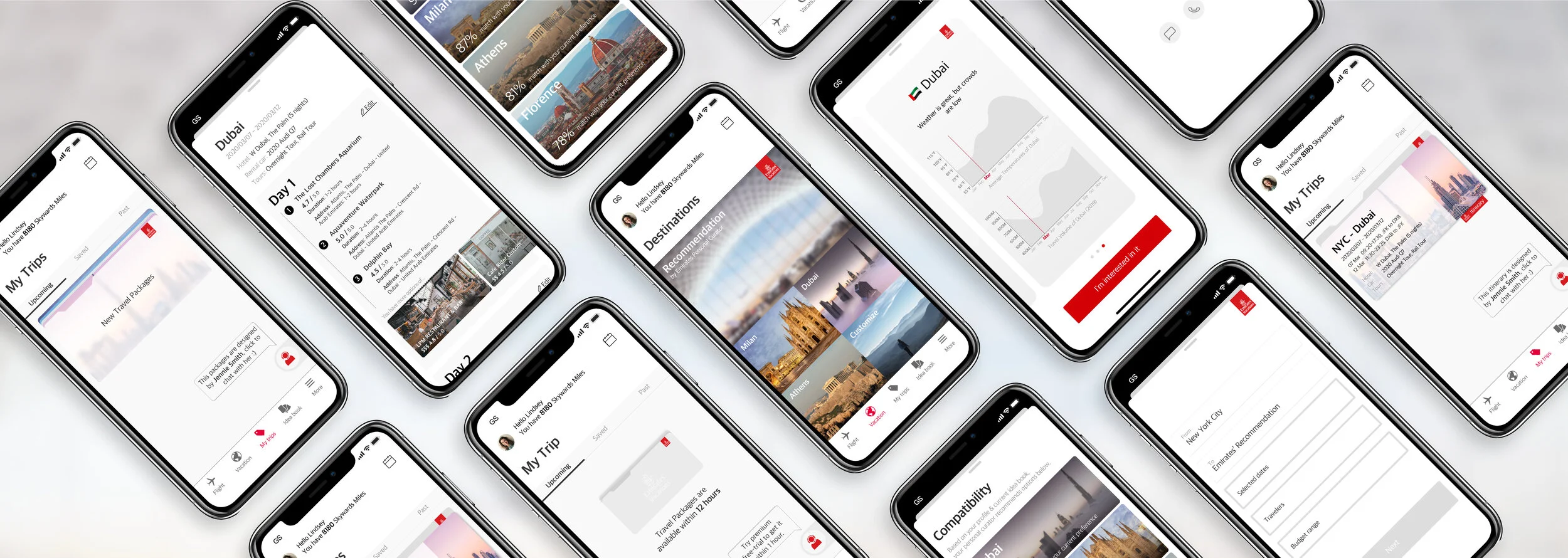
My Role: Product/UX Design Lead
Context: Emirates Group Sponsored CMU Integrated Product Development Course Project (Capstone)
Initial Problem Statement
Increase passenger volumes and raise awareness of Emirates in the US market
utilizing the Emirates Vacations platform.
Background
The travel and tourism industry has seen a significant shift over the past 20 years. Gone are the days of going on pre designed tours with tour operator guides. Instead, the world has seen numerous DIY options come onto the scene, such as Expedia, Hotels.com, Booking.com, Kayak, and others. Emirates Vacations has a unique platform to capitalize on changing consumer behaviors. Currently, Emirates Vacations offers vacation packages to selected international destinations around the world. It mostly offers packages consisting of hotel, airfare, and ground transportation. They also book tours and excursions, for example a Dubai city tour or a safari in Kenya.
Opportunity
How might we help busy travelers reduce confusion & frustration
when planning & booking vacations to unfamiliar places?
The Solution
A digital service which suggests customizable vacation packages (destinations, lodging
and boarding, air and ground transportation, itineraries) to travelers based on their preferences
crafted by experienced and knowledgeable travel curators with the following highlighted features:
01-
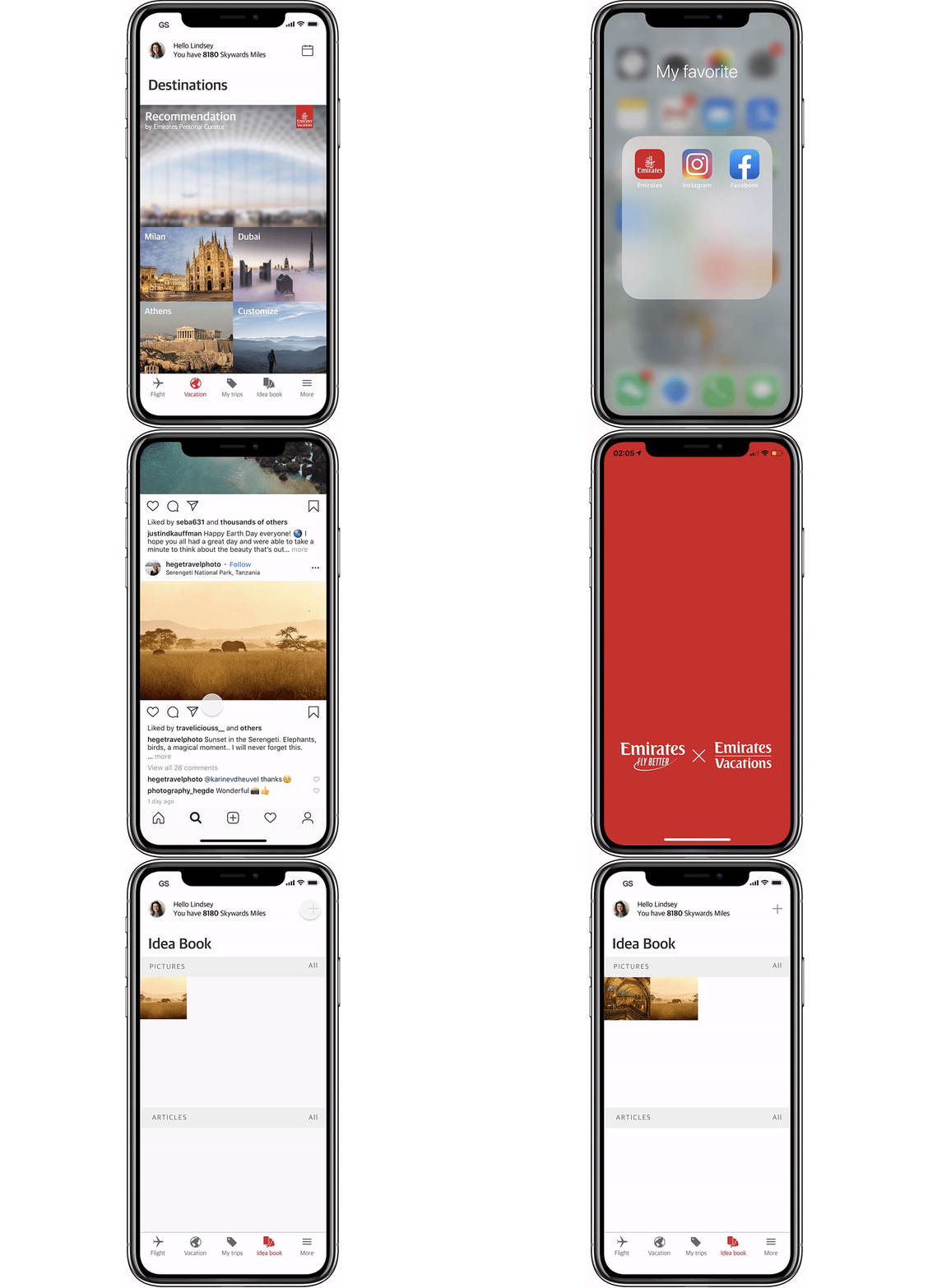
Utilize an innovative process defined as “Idea book“ to learn more about the customer preferences.
02-
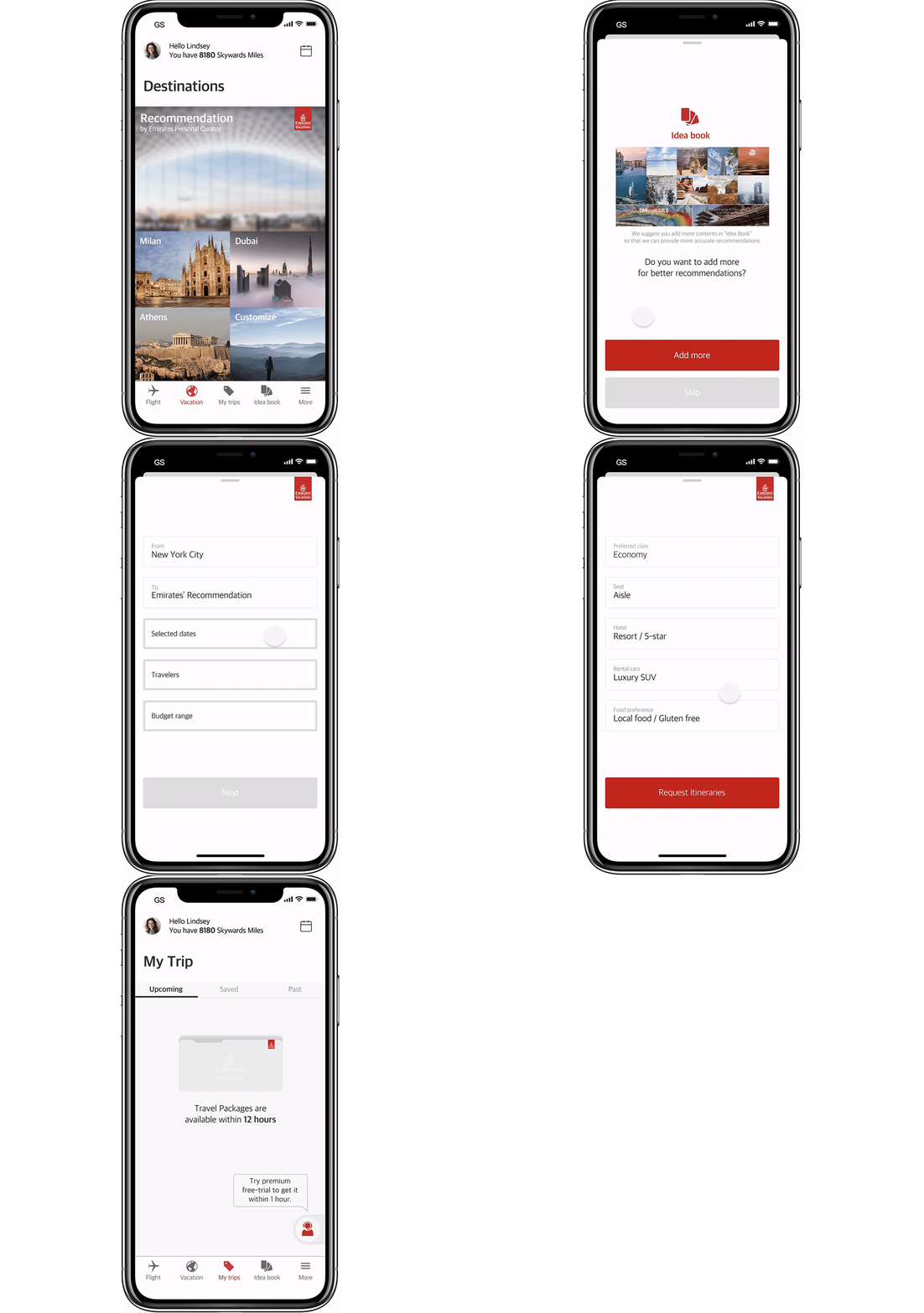
Request personalized travel packages based on travelers’ preferences.
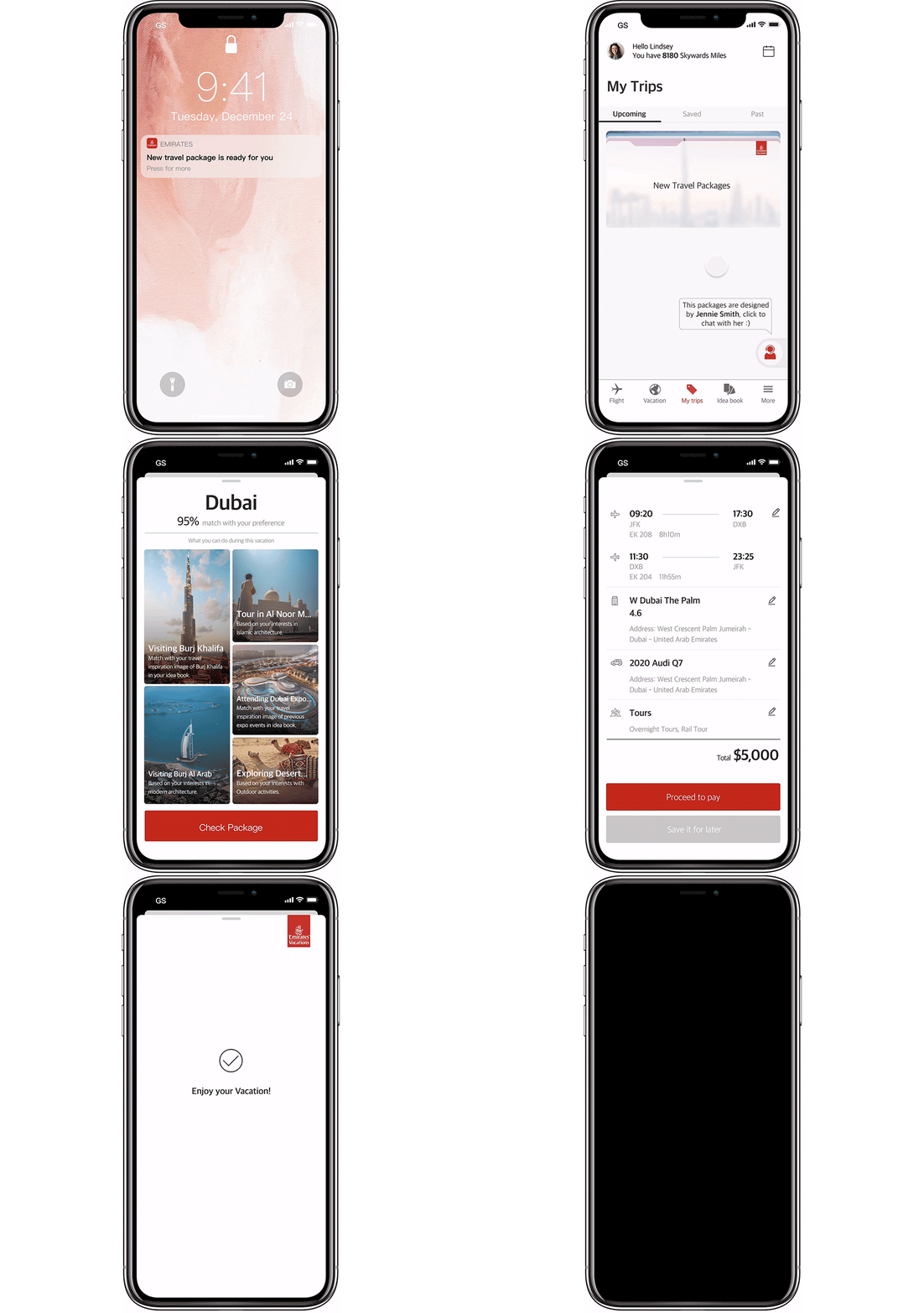
03-Create tailored packages with compatibility ratings for various destinations.
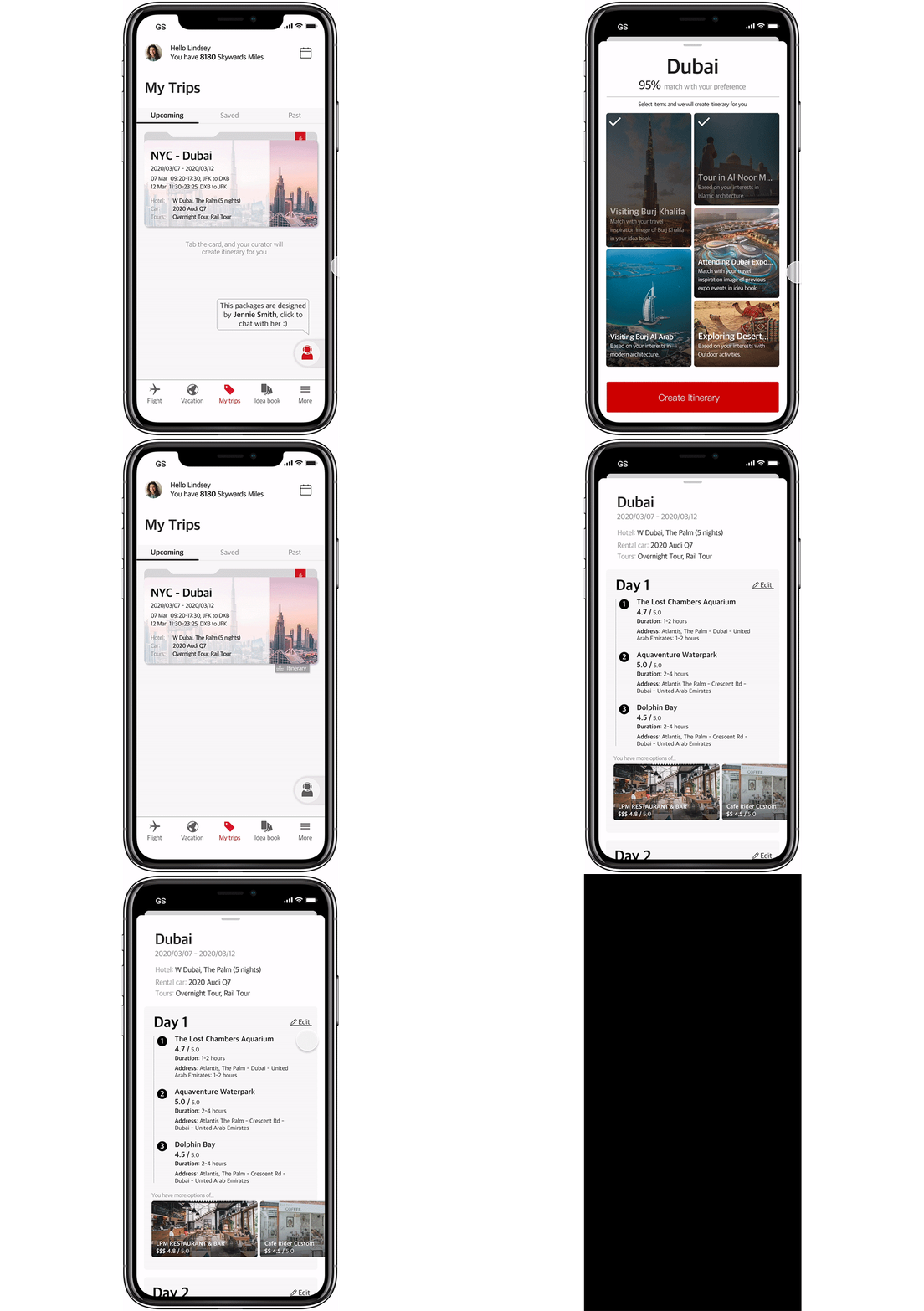
04-Suggest highly-crafted daily itineraries for customers conforming to their preferences.
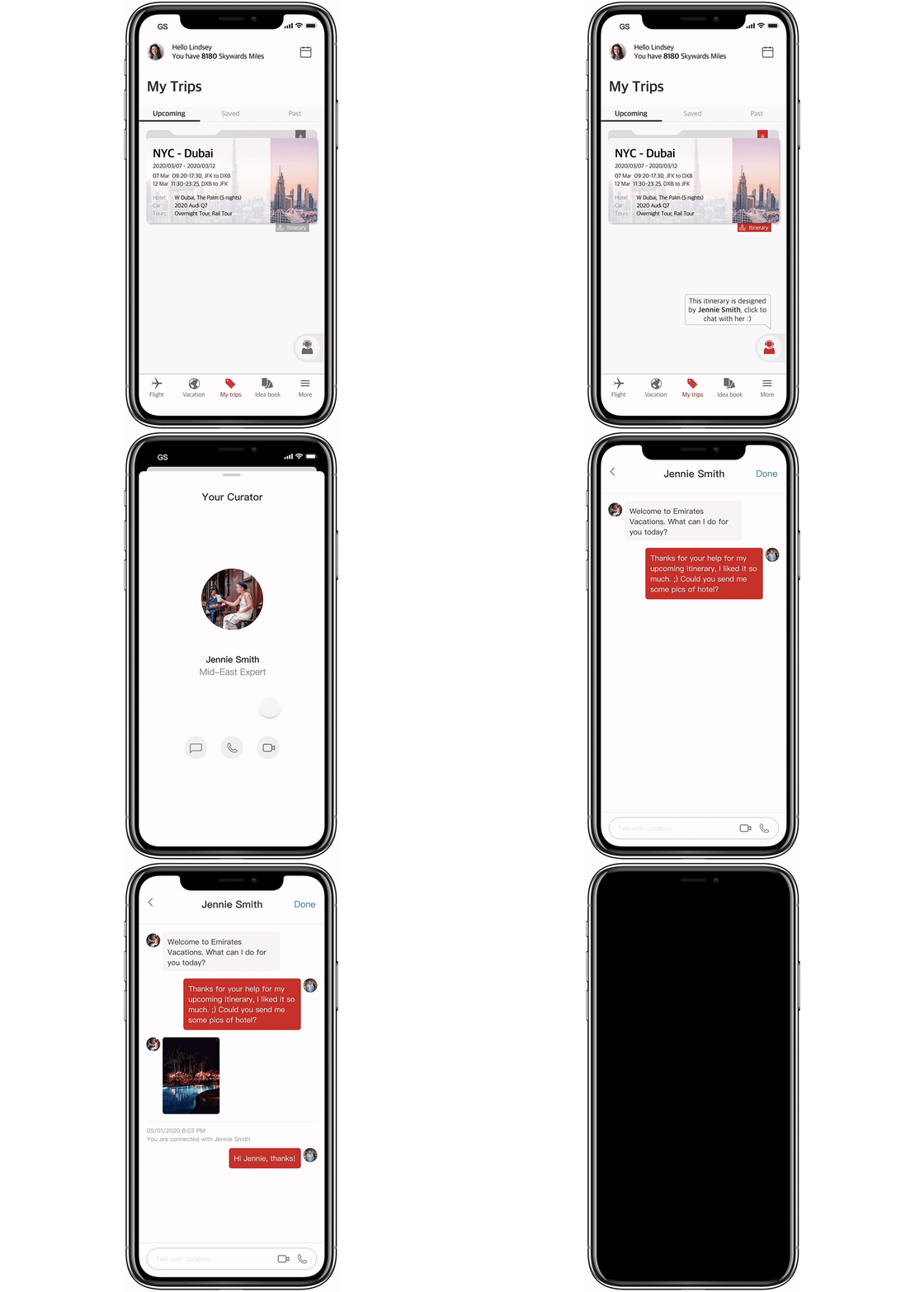
05-Seeking the assistance of exclusive personal curator, the one who designed tailored packages & itineraries.
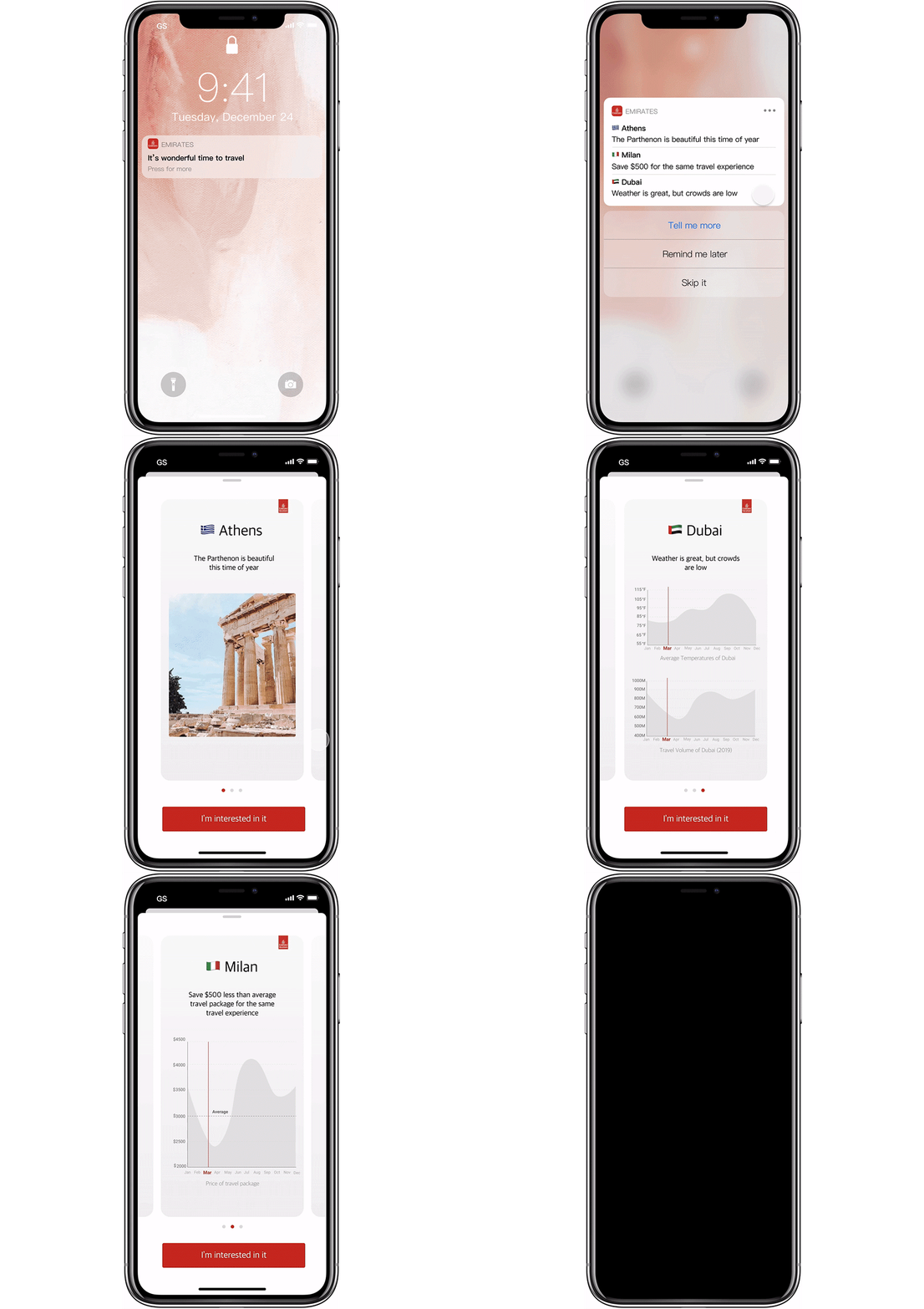
06-
Nudge users to consider next adventures by sending customized notifications.
Design Process
The overall goal of the project is to find solutions to help Increase passenger volumes and raise awareness of Emirates Vacations in the US market. Throughout the whole process of the project, we actively engaged with the key stakeholders by conducting primary research, background research of the travel industry, prototyping and multiple rounds of usability testing to have a good understanding of target users and needs that the solution is intended to meet.
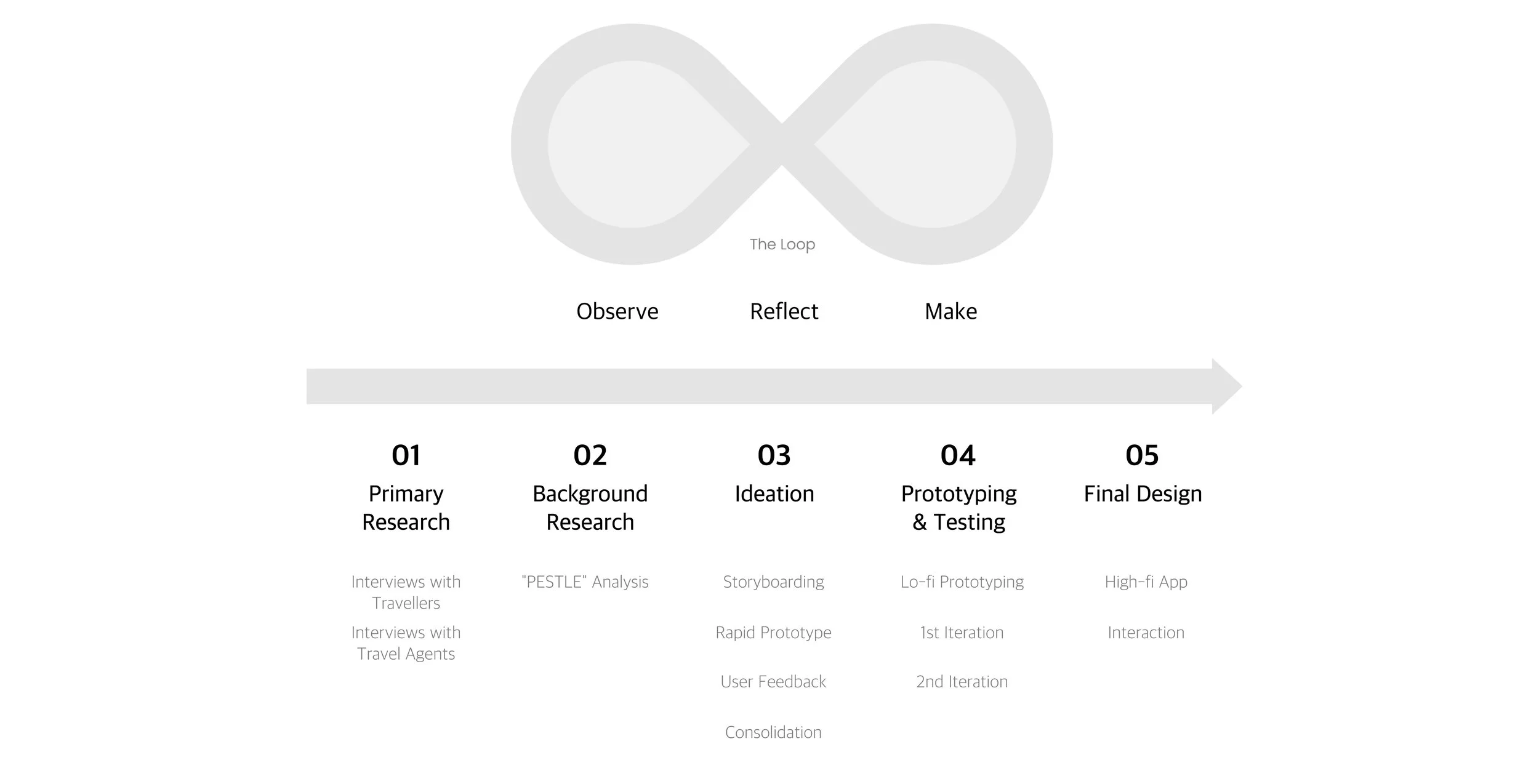
01. Primary Research
with Key Stakeholders
We started conducting user interviews in order to gain insights on traveler needs and pain points when it comes to taking an international vacation. Considering the different stakeholders involved, we also conducted interviews with local travel agencies in North America to understand users and markets from the perspective of the merchant.
Interviews with Travelers
In order to gain insights into the thought process, motivations, points of satisfaction and points of frustration of travelers, we conducted multiple one-on-one exploratory interviews. The goal of these interviews was to uncover the thought process landscape, using in-depth interviews with a diverse yet feasible sample of ten interviewees.
Key Insights from Travelers
Insight 1:
While there are multiple channels in booking a complicated trip, the travelers
prefer expert help thanks to their ability to provide authenticity and reduce confusion
due to information overload.
Insight 2:
The traveler expects a streamlined booking process.
Insight 3:
While the traveler trusts the agent, they still desire the freedom of choice,
therefore there is a time gap between the initial contact and final booking,
in which the traveler tries to evaluate the value for money,
exchange ideas with other stakeholders and makes a decision.
Insight 4:
The traveler likes to explore adequate options before making a decision,
but can not spare enough time in their busy daily lives to do all the research.
Interviews with Travel Agent
In addition to speaking with travelers, we spoke with three travel agents to understand their point of view. In general, most of the insights already mentioned were confirmed. However, a few new points were made about the process that travelers go through.
Key Insight from Travel Agent
Insight 5:
Companies in the travel industry focus less on the initial stages of planning a vacation
(i.e inspiration, Initial research and sharing) where the users face mental stress
and decision fatigue in decision for a vacation.
02. Background Research
In order to understand the existence of potential market segments derived from customer needs discovered through user research, we tried to identify if they were supported by any trends in the industry. We did this by doing secondary research in several areas (PESTLE - Political, Economic, Social, Technological, Legal and Environmental) leading to several impactful trends, constraints, and drivers. The most relevant trends to the primary research are stated below.
75% of Americans now work more than 40 hours per week.
57% of US travelers feel that brands should tailor their information based on
personal preferences or past behaviors.Top-deck Travel Product Manager Nick Wright states, “Nowadays, travelers are
looking for authentic travel experiences – a chance to immerse themselves
fully into a culture, try out activities that locals do, and eat like them, too.”The average traveler spends 53 days looking at 28 different websites before
they make a travel purchase, generating huge volumes of data about likes, dislikes,
travel dates, brand preferences, and shopping habits.
Product Opportunity Gap
The key insights from our research led us to the following opportunity statement.
“How might we help busy travelers reduce confusion & frustration
when planning & booking a vacation to unfamiliar places? ”
Translation into Product Requirements
All of the prior researches point towards product requirements which are necessary to add significant values to travelers. The following product requirements are in order of priority. This priority was assigned by comparing how well each requirement fit within the research.
Provide adequate information to help make a decision quicker and reduce uncertainty.
Understand travelers’ motivation and guide the process accordingly.
Accurately cater to the specific personal needs of travelers.
The booking process is intuitive & user-friendly.
Give travelers the freedom of controlling the itinerary.
Originally, we were challenged with growing Emirates’ US market presence. However, we feel that we can add even broader value to the overall market, while continuing to address immediate concerns. We have cultivated a thorough understanding of travelers through one-on-one interviews, background research of trends and other driving forces, and analyzing what travelers value and current marketplace offerings. The product requirements generated through this research will feed into the creation of a product or service that adds significant value to the travelers and stands tall in the travel domain.
03. Ideation
Once the consumer values and product requirements are identified, the work of ideation began in earnest. The first stage of this process was to brainstorm as many ideas as possible, keeping faith that any idea is valid at this juncture. Even the most ludicrous ideas may spawn something that is truly innovative. Then the rapid prototypes enabled the team to get preliminary user feedback and further refine the concepts. Once refined, the concepts were evaluated against a set of criteria in order to down-select to a final concept. In our case, several final concepts were able to be combined as they are different touch points along the user journey through our service.
I . Brainstorming
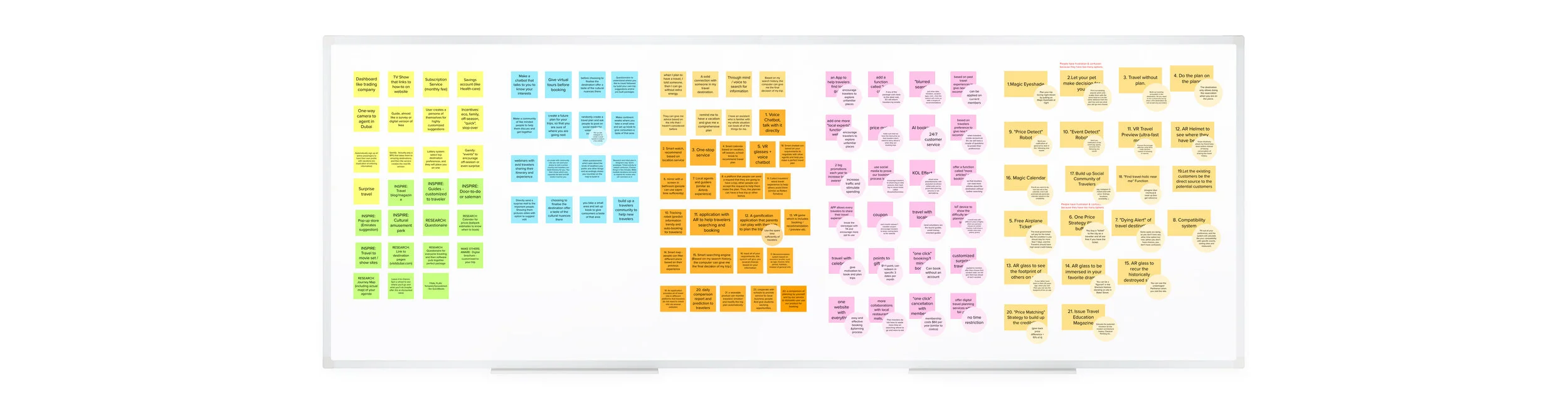
The ideation process began with our team generating more than 100 ideas centered around our product requirements, including but not limited to features, potential technologies, mediums and services. While there could be ideas that overlapped, as mentioned before the focus was on generating more ideas to have the luxury of choosing, combining in the future.
II . Affinity Grouping
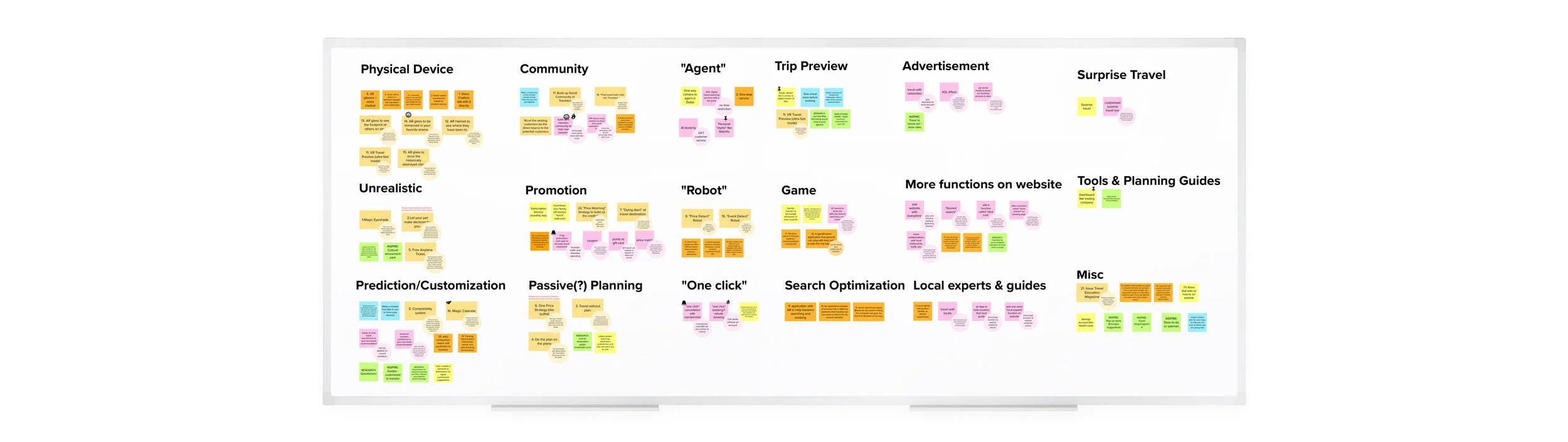
Then these ideas were grouped into categories based on their similarity with each other.
III . Rapid “Pretotyping”
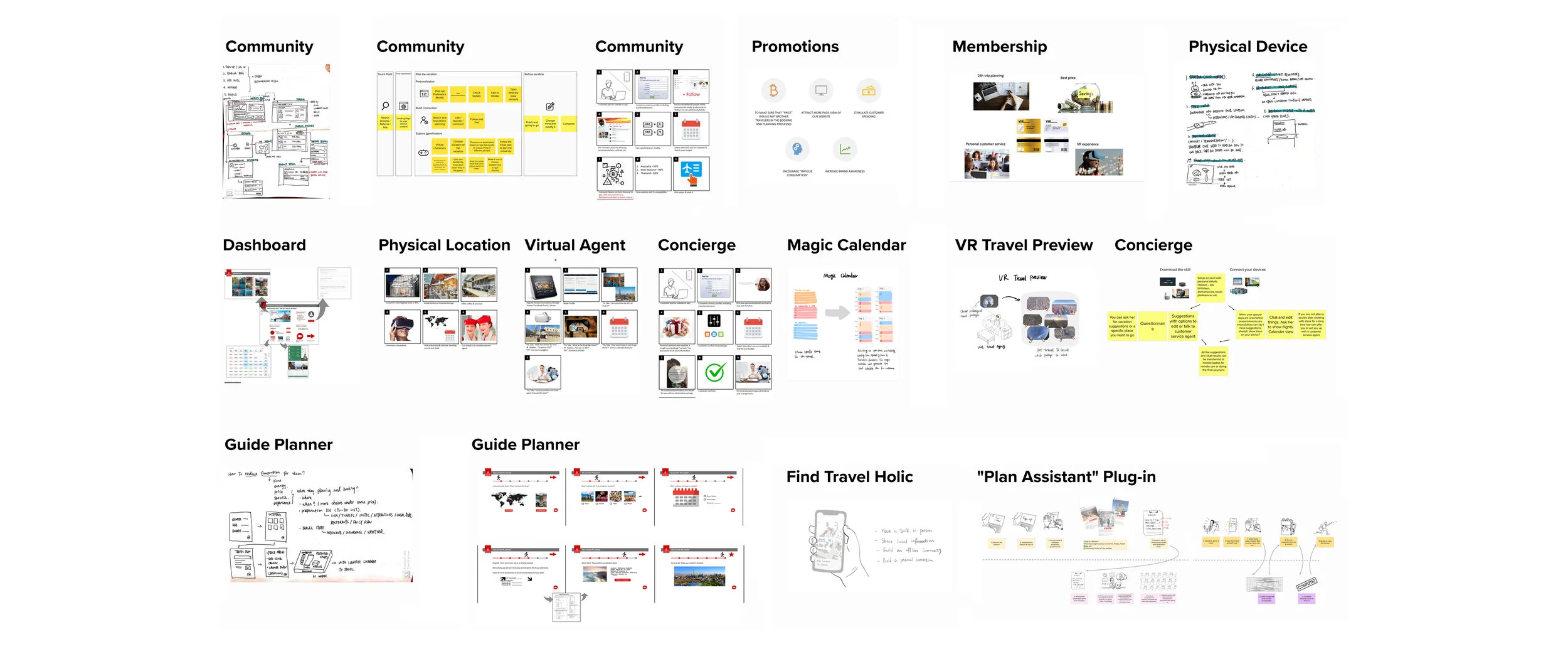
The ideas under each category were synthesized, pulling valuable elements out of them and reconvene those elements to build prototypes being able to validate the potential of the ideas. Rapid prototypes were built using storyboards and wireframes by constantly reflecting on the values of the original ideas. The idea of rapid prototype centers around getting as much feedback as possible from the least amount of effort. In this manner, we successively built 17 quick concepts.
IV . Synthesis
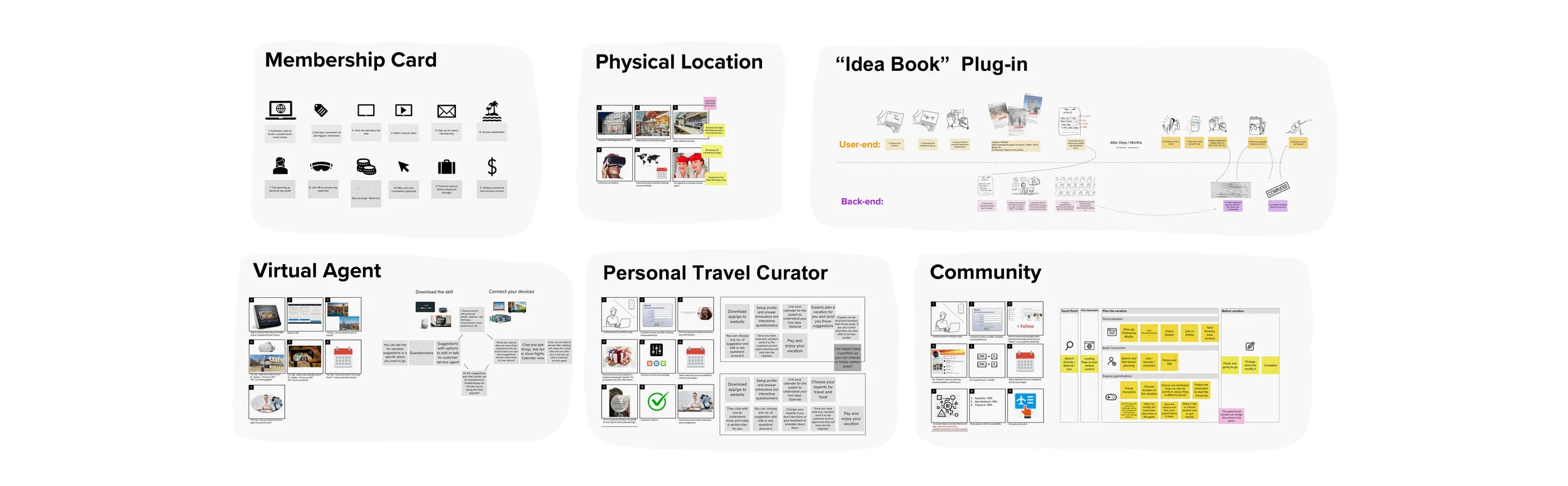
Based on feedback on the concepts within the team we iterated and synthesized the first-round prototypes into six main concepts. Building these concepts allowed us to begin to evaluate them critically and understand the pros and cons of each idea.
V . Evaluation
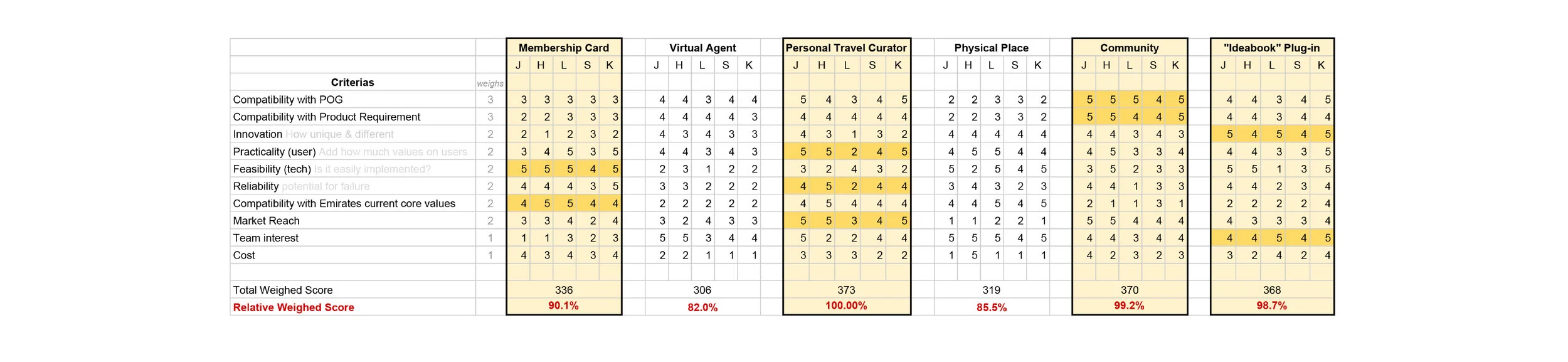
Then we evaluated the concepts based on the criteria of compatibility with opportunity & product requirement, innovation, practicality, feasibility, etc. to analyze the advantage and disadvantage of six concepts. These criteria were internally decided and weighted based on their importance to help gauge the value of each idea.
VI . User Feedbacks
Next, we sought feedbacks from travelers who matched our targeted customer segment of busy travelers. The feedbacks mainly focused on understanding whether the travelers found value to fulfill their needs.
Users like the “Personal Travel Curator” and “Idea Book plug-in” as they prefer
human service to computer or robot.Users are fond of the idea of being able to talk to the same travel expert to
resolve their concerns, the idea book was perceived as something that can help
them to organize and save their instant thoughts and provide them whenever
they need inspirations for next travels.For the “Membership Card” business model, users were excited about having
“one-click” cancellation service as they usually have concerns during the booking
phase of unpredicted emergencies.Users have huge concerns on having another social media platform as they did not
see a huge difference from other social media platforms on “community” concept.
VII . Consolidation
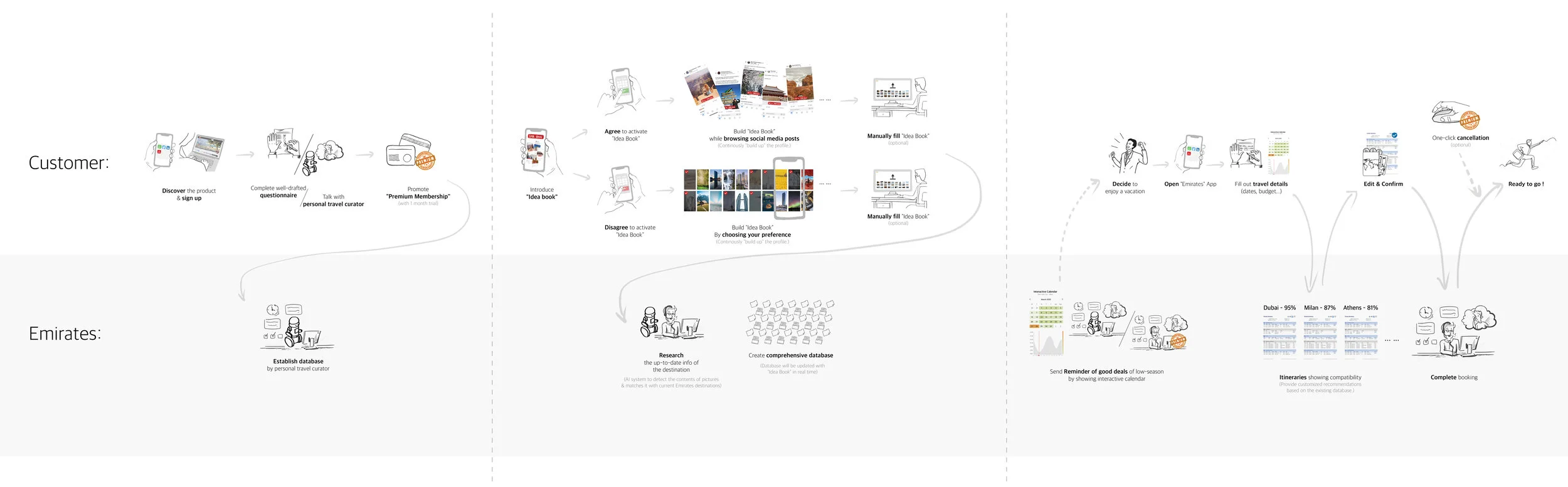
Based on user feedback and internal reviews on the six concepts, we decided to move forward with the “Personal Travel Curation” idea with “Idea book” plug-in as the supportive feature and “Membership Card” service as guidance of business model. Our solution is a digital service which suggests customizable vacation packages (destinations, lodging and boarding, air and ground transportation, itineraries) to travelers based on their preferences crafted by experienced and knowledgeable travel curators.
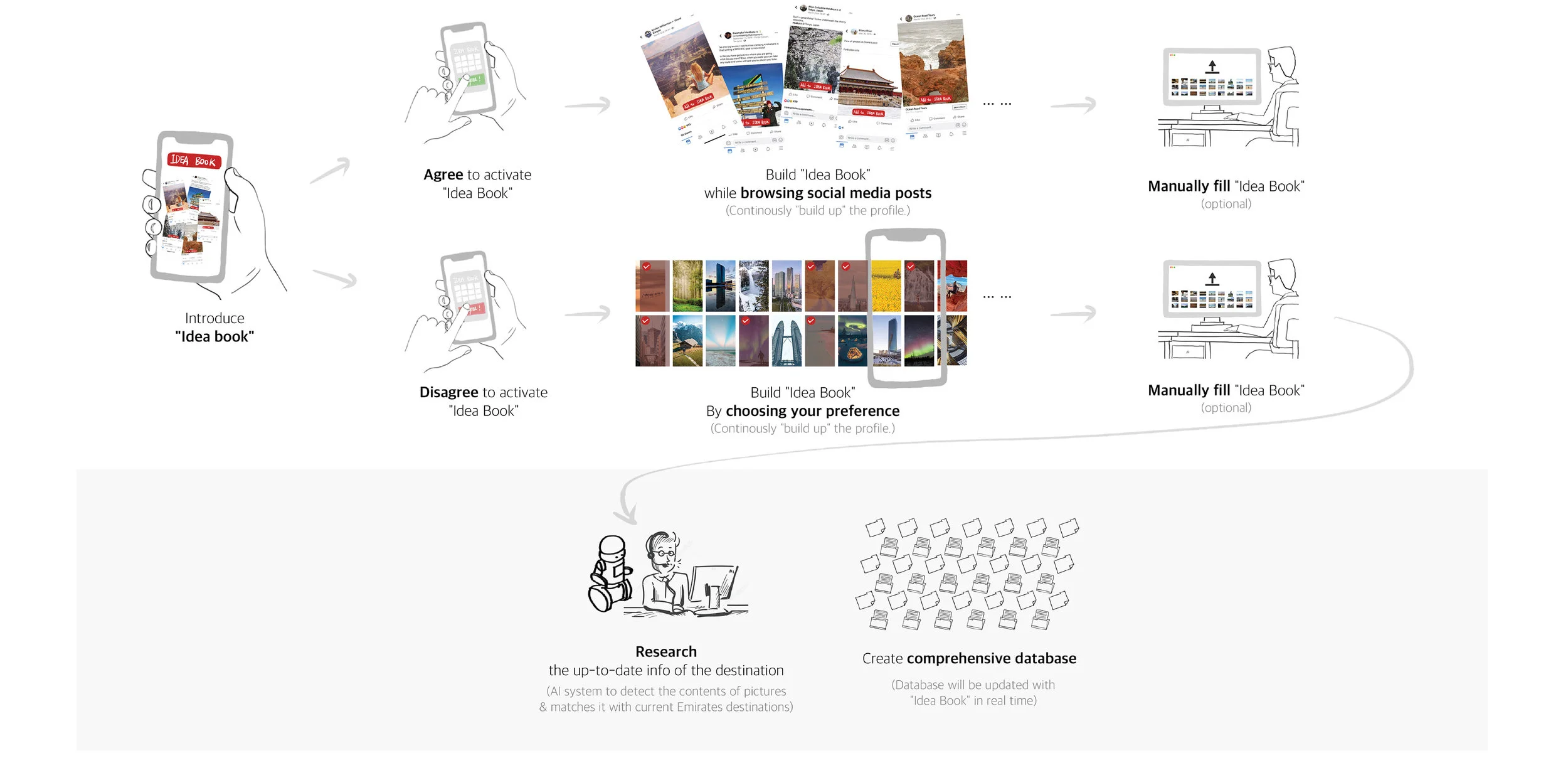
01 . Discover & Setup
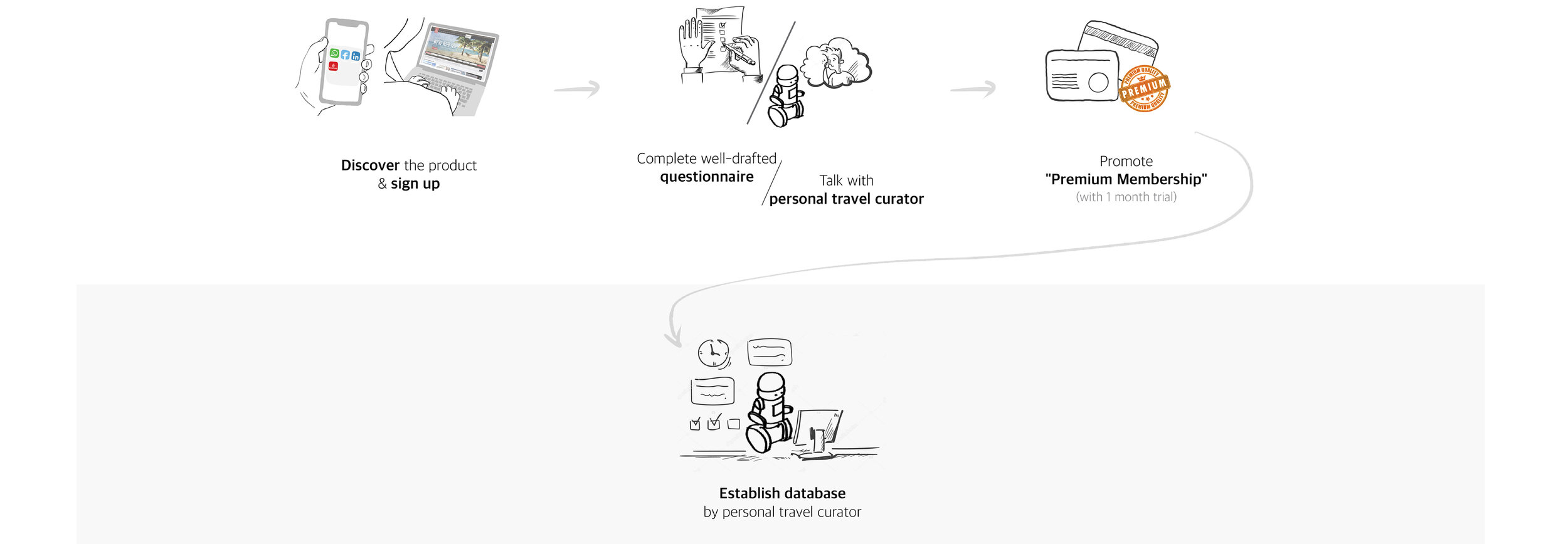
02 . Build Preference
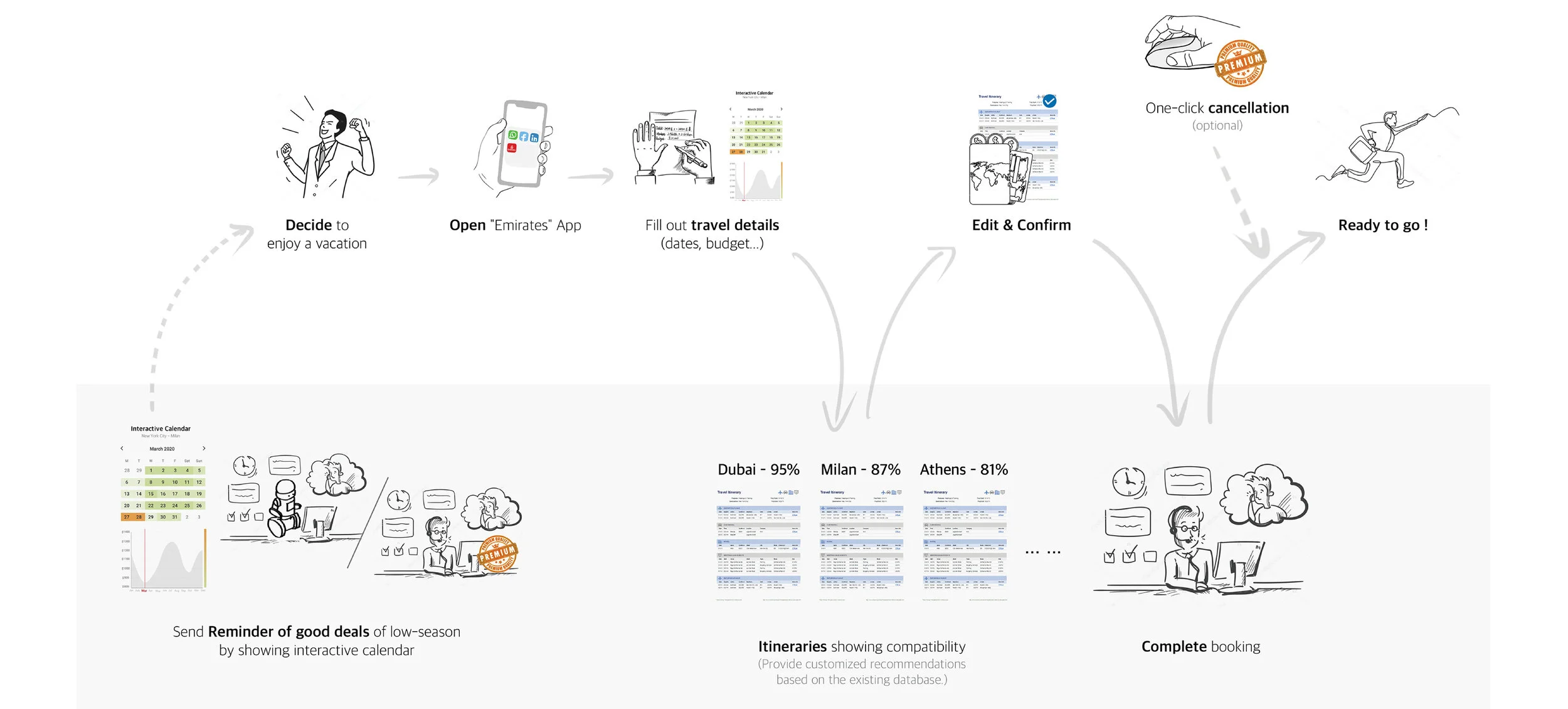
03 . Complete Booking
04. Prototyping and Testing
Through our ideation phase, we gained better understanding of what users need, which guided us to the prototyping and usability testing. We had three rounds of prototyping in total and two rounds of testing among them. The second round prototyping was an iteration of first round based on the first round testing, and the third round prototyping was an iteration of the second round.
Low Fidelity Prototyping
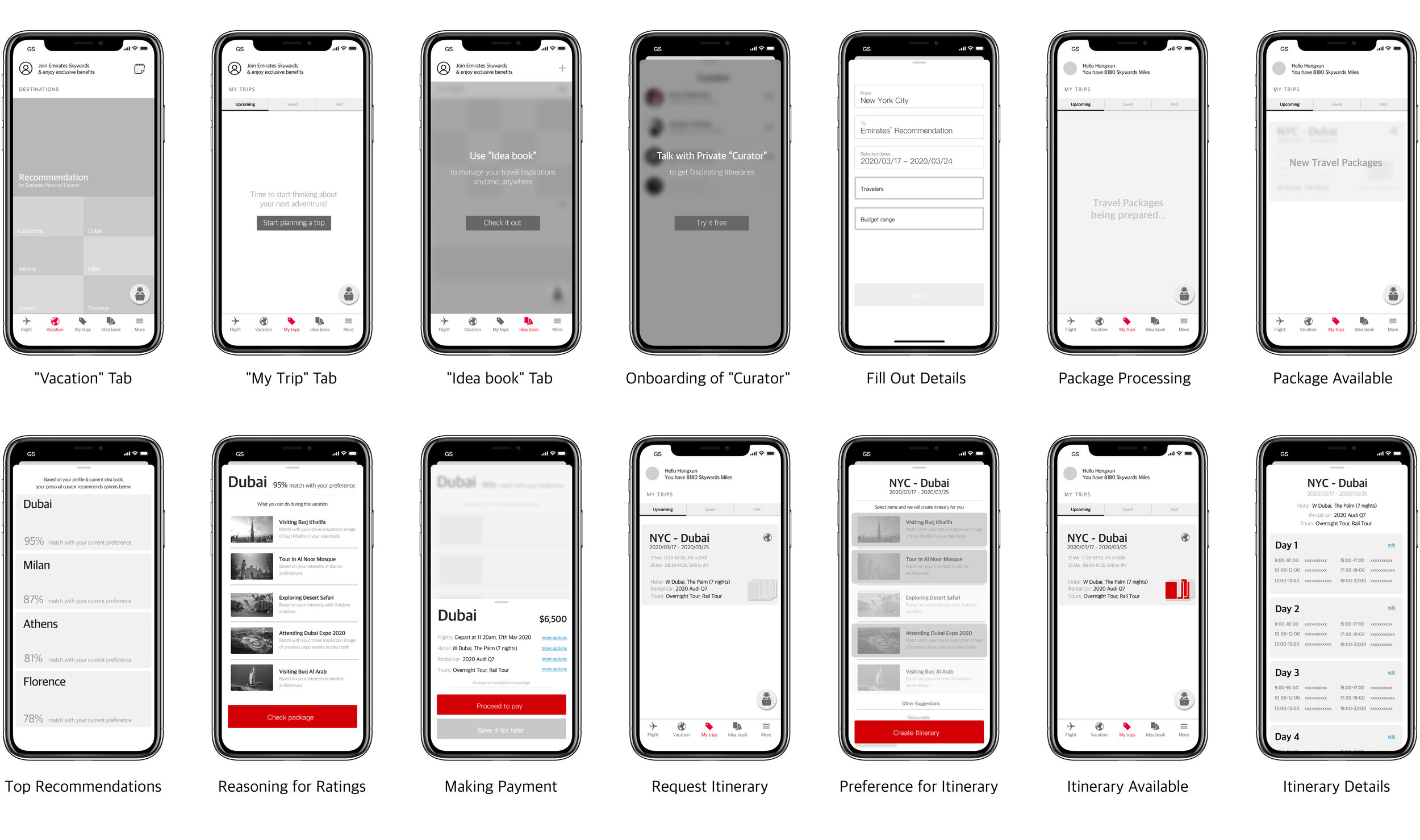
Our prototype aims to display the features that busy travelers plan and book vacations with the help of curation service being provided multiple travel options based on users’ preferences. Moreover, the prototype shows a clear user flow when navigating through each interface. Below are the key screens:

1st round testing & Iteration
After we finished our low fidelity prototype, we ran usability testings to get feedback about interfaces and design flow. We also collected constructive feedbacks and suggestions which helped us gain a handful of insights and findings. The major insights we got and improvements we made fell into three categories: On boarding experience, vacation Panel, compatibility ratings and highlighted features.
On boarding experience: Users mentioned they have no idea about how the travel
recommendation works and also some buttons like “Speak to curator“, “Idea book“ and
“Interactive calendar“. The tutorial for beginners is essential.
Vacation Panel: Separate button for vacation explorations, not under the “My Trips”. Currently,
the “Vacations” platform is accessed from the “My Trips” button (bottom of the screen). A
button that says “Vacations” is necessary. Or a section should be added to the Emirates
home screen that prompts people to go to the Vacations platform.
Compatibility Ratings: Users are confused as no explanation or reasonings behind the
ratings. They would trust the service if the explanations are reasonable and it will add
more credibility.
Highlighted Features: The access to curator, the interactive calendar & “Idea Book” should
be placed in a more easily accessible place.
2nd round testing & iteration
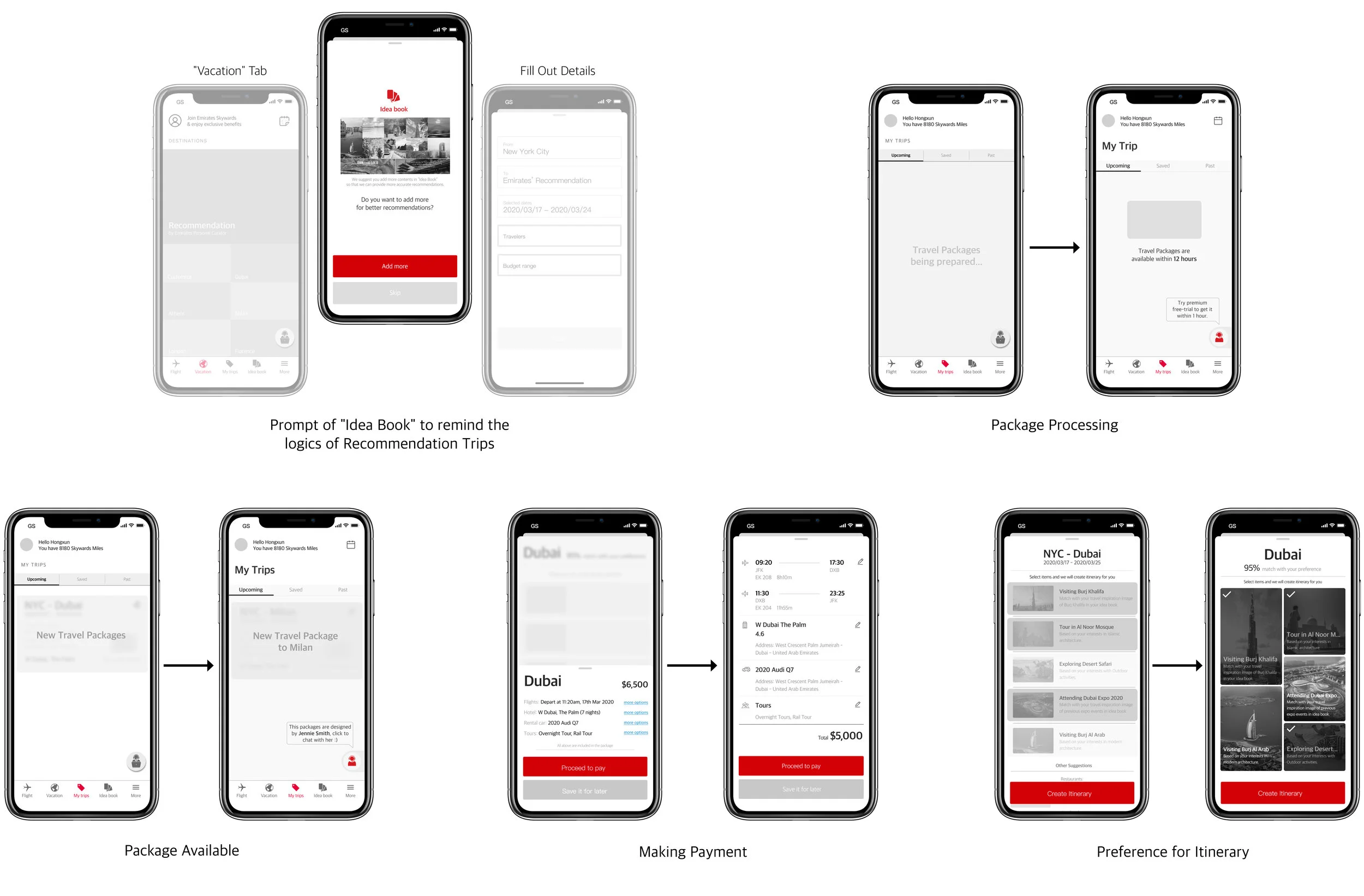
After the first round iteration, we conducted experience prototyping. We used the prototype to simulate a live experience with our product for the target users. After the experience prototyping, based on the notes we took during the sessions, we reiterated our lo-fi screens. The changes are as follows:
Reminder of “Idea Book“ being a critical factor for recommendation shows up
before filling out travel details.After finishing requesting recommendation trips, the access to curator should be
suggested for better curation right before and after the packages are available.The page of making payments should show adequate information in a more intuitive way.
When selecting preference for itinerary, the information card shows bigger portion
of images instead of previous small ones.
05. Final Design
Personal Travel Curation helps to bridge the gap between where you are & where you want to go
A digital service which suggests customizable vacation packages (destinations, lodging and boarding, air and ground transportation, itineraries) to travelers based on their preferences crafted by experienced and knowledgeable travel curators with the following features.
I . Learning the Preference of Users
Questionnaire
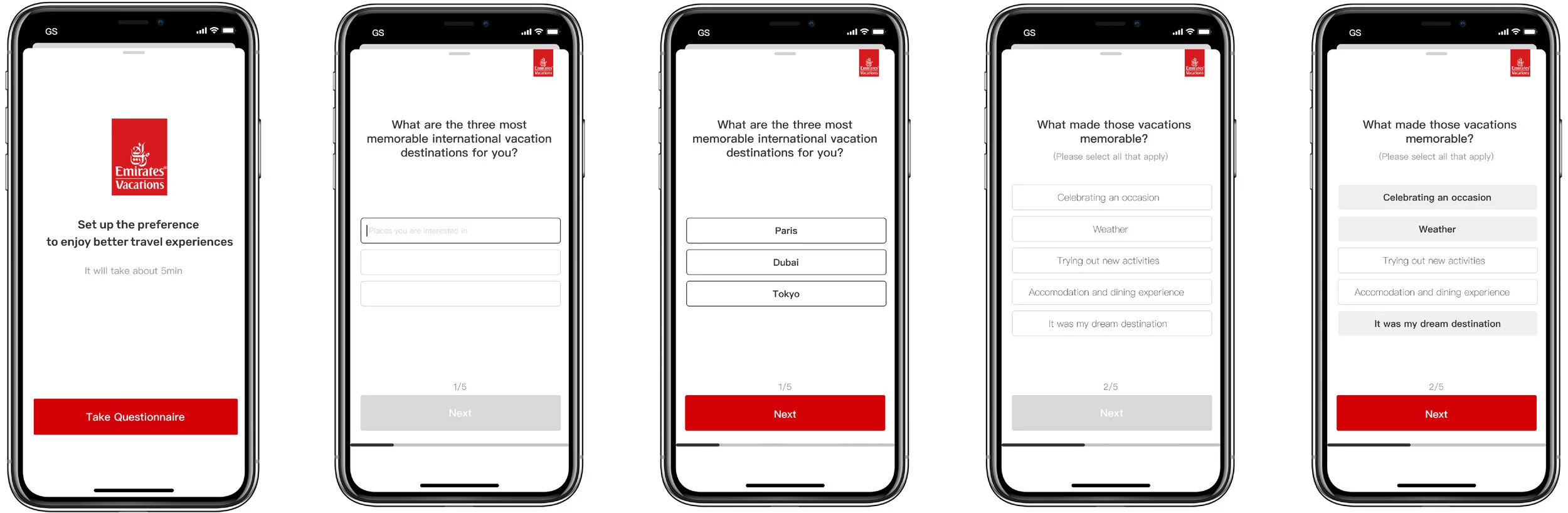
The questionnaire is the first step to understand travelers such as favorite destinations, travel types, etc. It is one of the easiest, cost effective means to learn about the users. The questionnaire was developed by studying multiple travel questionnaires in the market and curated to match our solution. The final version was developed after conducting multiple rounds of user feedbacks.
Idea book
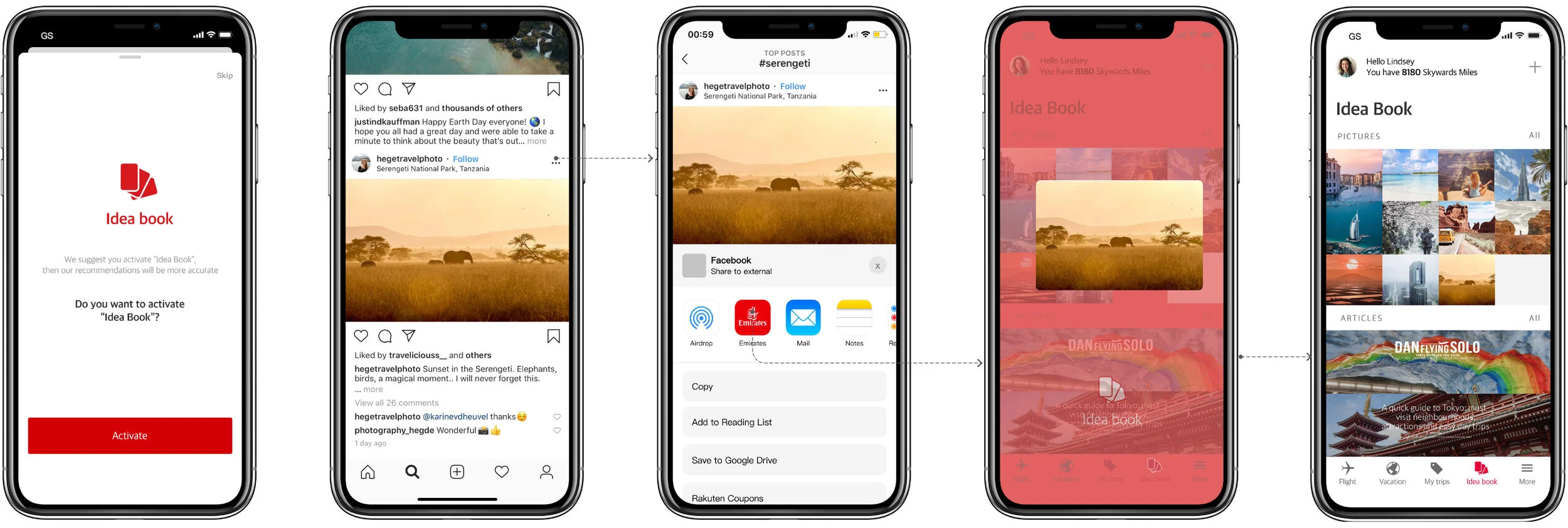
The Idea Book is a highlight feature of our concept which allows the users to easily save their inspirations/ideas through the images they encountered on the internet by utilizing their fragmented time. If they already have pictures in their devices or find something interesting in a paper materials, they are also able to manually add contents to the “Idea Book“.
II . Requesting Personalized Travel Packages
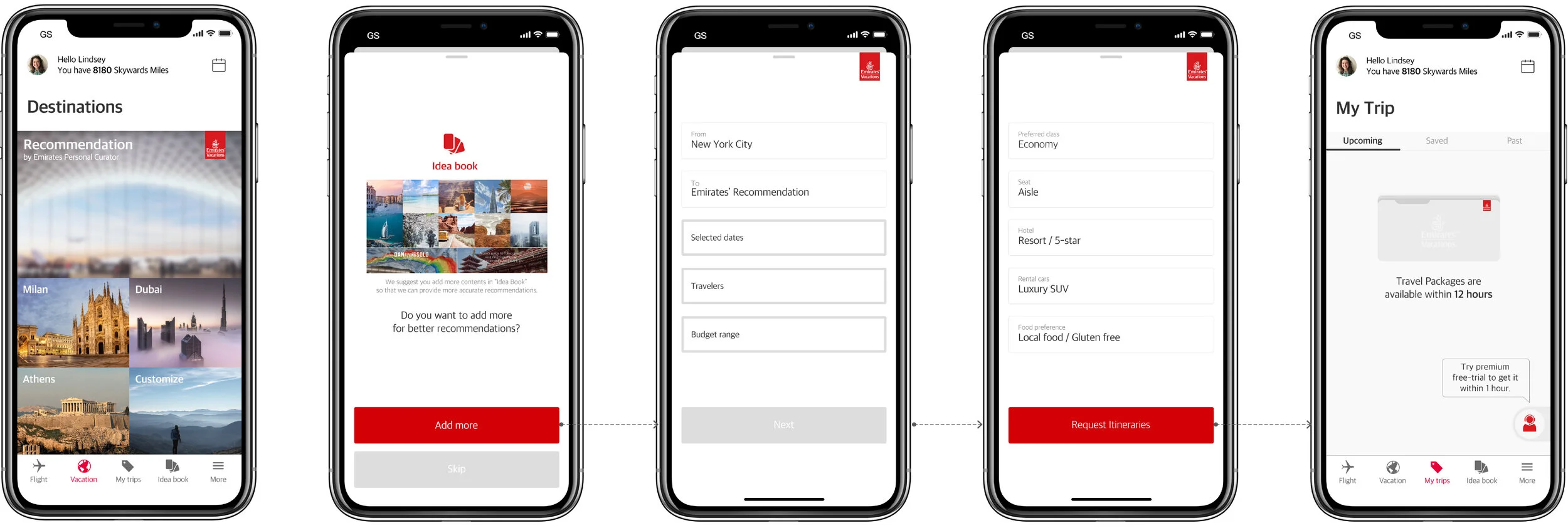
Once the travelers have decided to have vacations, but have no specific idea, they can simply fill out travel details, and then request recommended packages that would be designed by personal curator. They will be highly customized based on the already built profiles.
III . Creating Tailored Packages with Compatibility Ratings
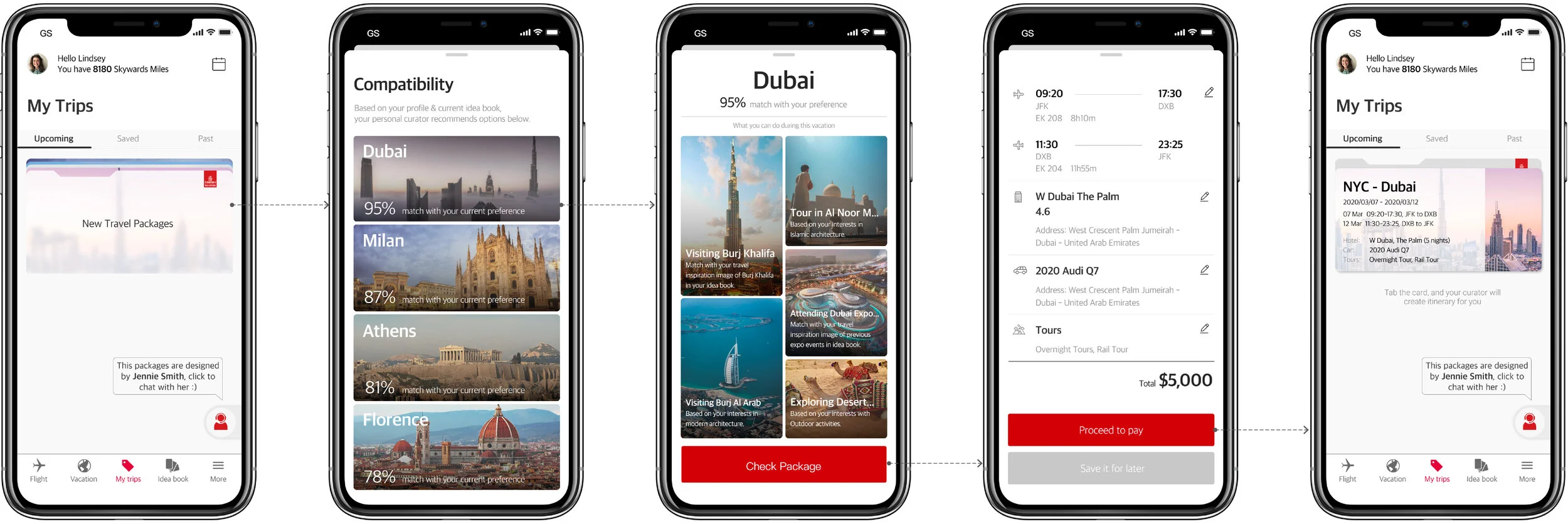
Next, the travelers would receive the notification along with tailored packages with compatibility ratings and the supportive reasonings behind the scores for various destinations and are able to easily make the final decision.
IV . Suggesting Highly-crafted Daily Itineraries
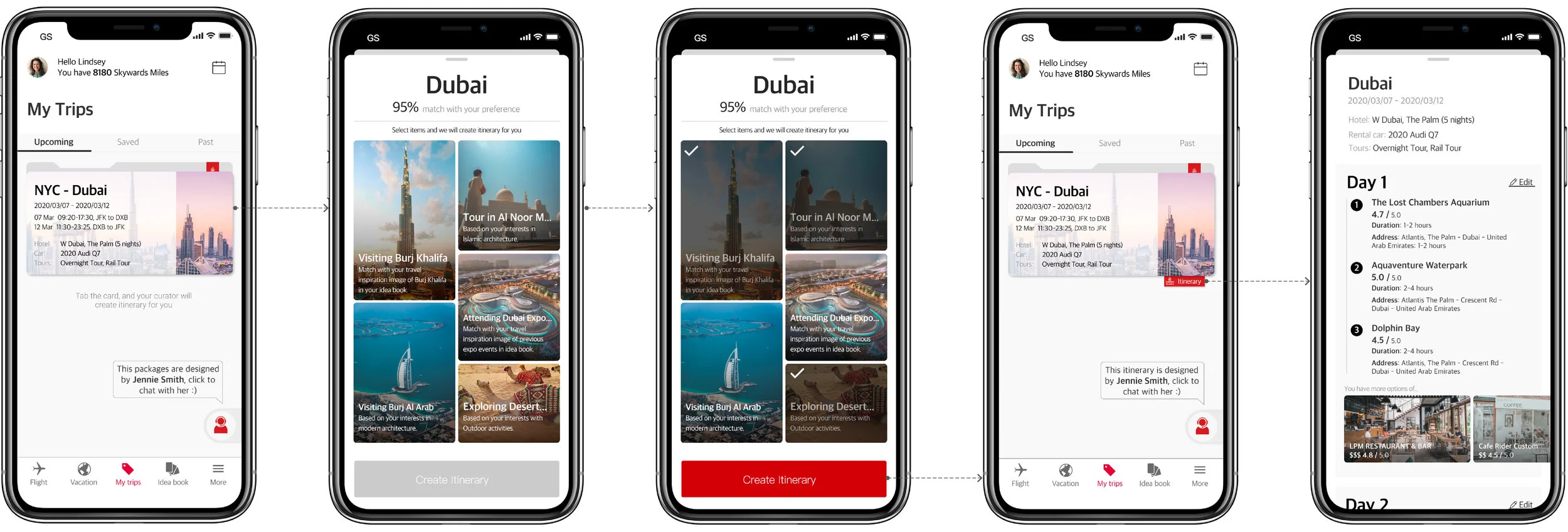
Once a package is booked, the travelers can select the local attractions, restaurants, and events they are interested in according to their preference built based on questionnaire and “Idea book“. The Curator will take this information and provide a suggested itinerary, considering time spent at each location and proximity to one another.
V . Receiving Customized Notifications for Next Adventure
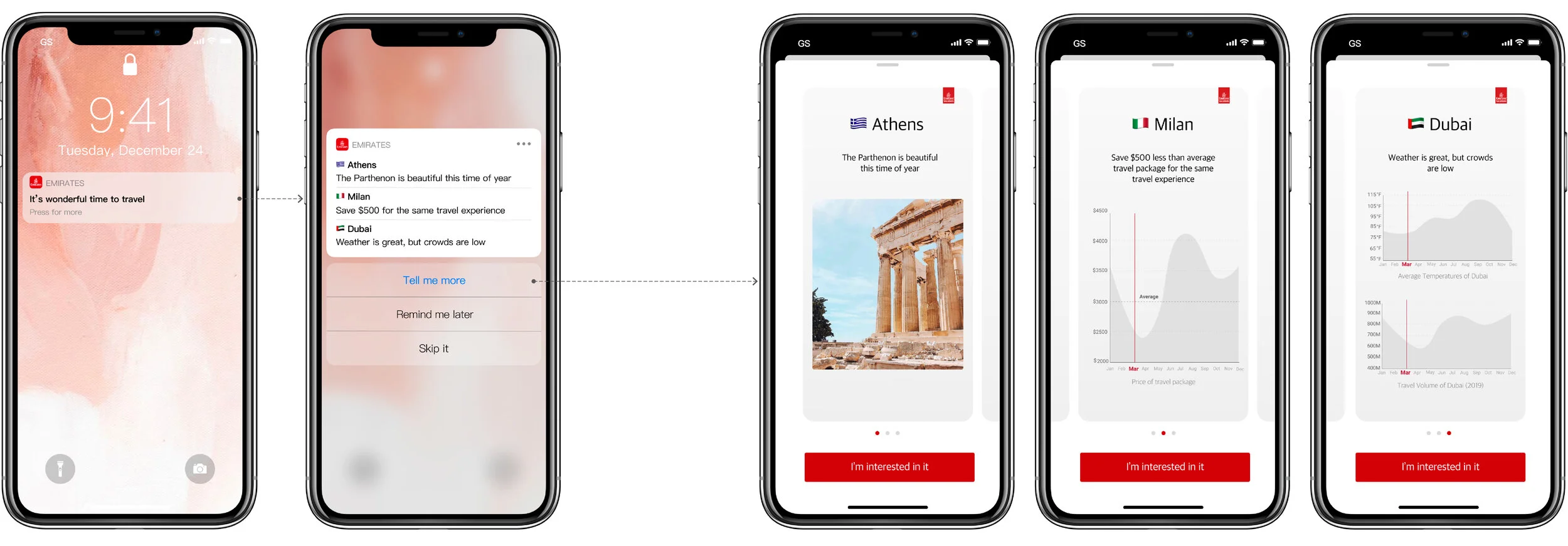
Push notification is an easy and effective way to communicate with travelers. The notification can be used to encourage exploration and to engage with travelers anytime. This can be especially effective during low seasons. By using appropriate language like “Now is a great time to travel”, you can encourage travelers to enter the app and begin further engagement.
VI . Seeking Assistance for Exclusive Personal Curator
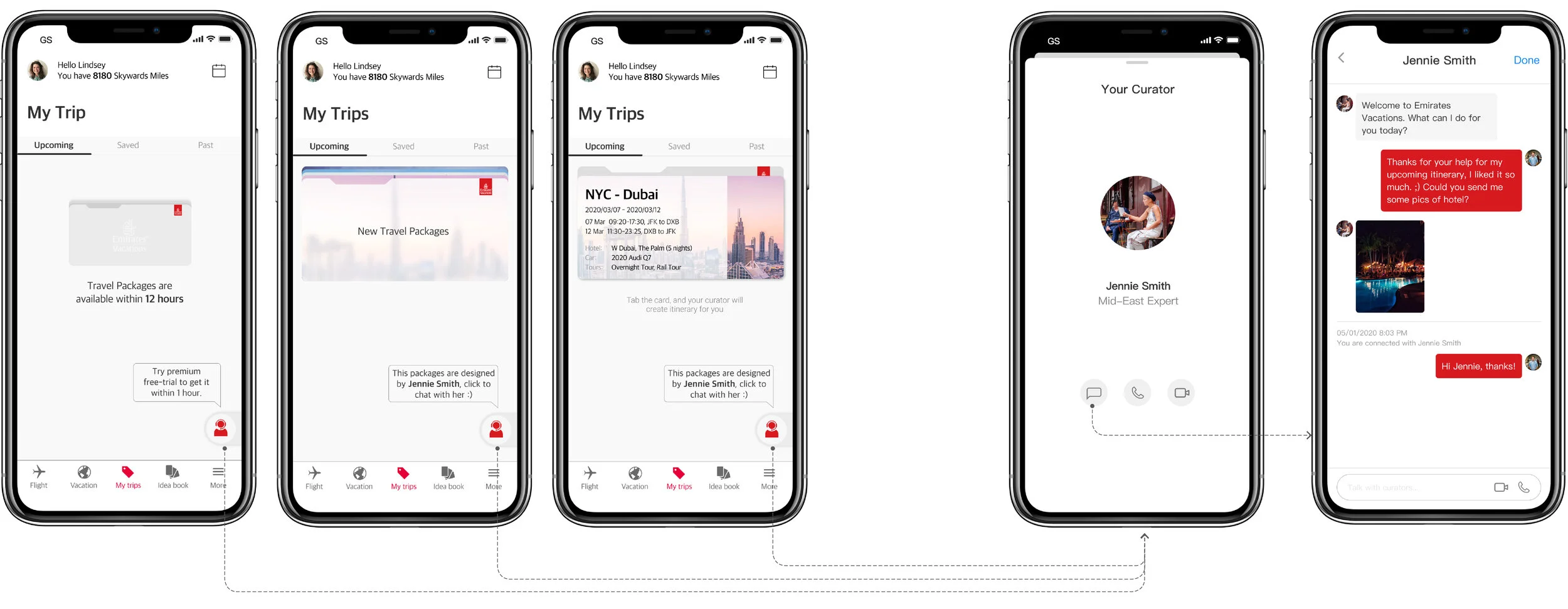
Travelers are able to seek the assistance of exclusive personal curator, the one who designed a high level list of travel options for the destinations through chat, voice or video call for any concerns on the planning and booking process.
Thanks for reading.